


Jamaleh Isfahan Press

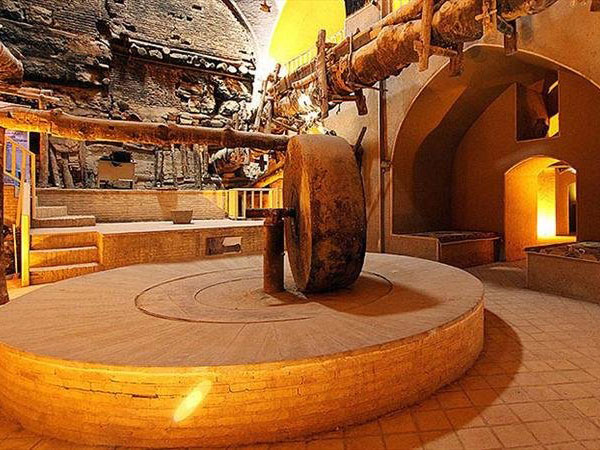
The Jamala neighborhood of Isfahan, close to Sheikh Bahai Bath, is the place where, by walking through the back alleys of Ibn Sina Street, we can immerse ourselves in a neighborhood that carries our history and past, a neighborhood where magnificent works of the Safavid era such as the Jamala oil mill of Isfahan are displayed on every side. In the past, oil was produced in this place for various purposes, including food, soap production, medical use, and tallow lamps.
Jamala
Introduction:
The oil mill referred to special mills that were used to crush stones, turmeric, pepper, etc., or to pour vegetable and oily materials into it to extract their oil or juice. In ancient Isfahan, there were about seventeen oil mills, of which only four remain.
The oldest oil mill is in the alley of Judh, which is located next to the Qandil-e-Sazha oil mill.
Another press house is located near Sheikh Bahai’s bathhouse (Jamalah Alley), which is operated in the same old way.
The third press house is called Shahi and was built in Mukhlis Bazaar, at the same time as the Mullah Abdullah School and other historical monuments of Shah Abbas the Great.
The fourth press house is called Pansang Pasang and is located in the Pasang neighborhood.
Sheikh Bahai’s press house in Jamlah Alley and Shahi press house in Imam Khomeini Square are two restored press houses in Isfahan that people can visit.
Jamlah
History:
Jamlah’s press house was built 400 years ago by Sheikh Bahai during the reign of Shah Abbas I.
This press house is registered as number 905 in the National Monuments List of Iran.
The area of Jamlah’s press house was 1800 square meters, but over time some parts of it, such as the camel stall, the dock and the entrance to the press house (counter), were destroyed.
The Jamlah press house building is two stories high.
The ceiling of the oil press is made in such a way that the temperature of the room is always cool and the oil is kept at a low temperature.
Jamala
How it worked in the past:
First, the desired grain was mixed with water.
Then, the oil grains were poured onto a large circular millstone called a “baghal kesh”.
Then, another stone, which was in the shape of a thick circle and was called a “barmali”, was pulled over the grains.
When all the trays were filled with yeast, they were placed in a pit called a “pachal”.
There was a very large wooden beam thirty meters long in this place, called the “Shah Tir” (the king of the beam). With the help of a lever, a large pulley was turned so that one side of the beam went up and the other side, which was towards the trays, went down, putting pressure on the trays, and the oil that was in the form of a paste on these trays overflowed and was poured into the pachal.
Finally, this oil was collected in a container and poured into the vats.
Different sections:
Pishkhan
Barandaz
Shatkhan: A place where heavy loads were brought into the oil press by camel from this place.
Tirkhaneh: The lower floor of the oil press was known as Tirkhaneh due to the presence of wooden beams of the oil press.
Garmkhaneh: This place, which is the upper floor of the oil press, was used to roast oil seeds.
Unfortunately, the counter, bar counter and camel stalls of Jamala’s Assarkhaneh have been destroyed in the present era and have been converted into a gold market.
Address: Isfahan, the beginning of the Grand Bazaar, Sheikh Baha’i Alley (Jamala Alley)