


Minaret in Dardasht

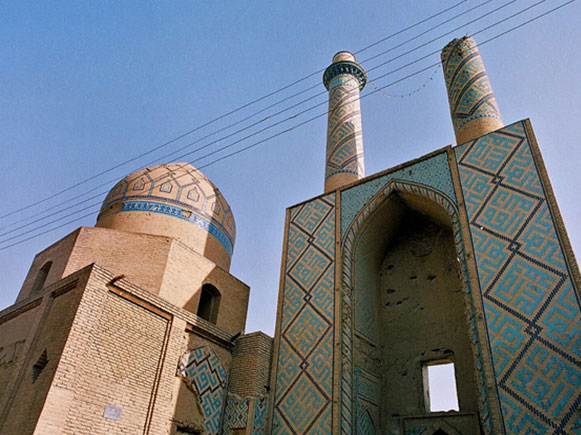
When you hear the name of the minaret, the first name that comes to your mind is definitely the Shaking Minaret. But Isfahan has many other historical minarets that may not be as famous as the Shaking Minaret, but are historically very old, such as the minarets in Dardasht of Isfahan (Sultan Bakht Agha Tomb).
Dardasht
Introduction:
The minarets in Dardasht of Isfahan date back to the seventh and eighth centuries of the Hijri calendar and the Ilkhanate period.
This monument was registered on January 15, 1310, with registration number 115 as one of the national monuments of Iran.
The tomb of Sultan Bakht Agha, the wife of Shah Mahmud Mozaffari, is located in this place and next to the minarets.
During the reign of the Al-Muzaffar dynasty, there was a magnificent school in this place, the remains of which can now be seen.
This building had suffered numerous damages over time, which were restored with the efforts of the provincial Cultural Heritage Department.
Among the restoration measures of this historical building are the lightening and insulation of the roof, the foundation and repair of the plaster walls of the tomb, and the strengthening of the side walls.
Other measures include the reconstruction of the courtyard arch, the wall banding, the implementation of the brick carpet floor, and the restoration of all plaster and clay straw parts.
This building is now in the possession of the General Endowment Department of Isfahan.
History:
Shah Sheikh Abu Ishaq was the last ruler of Al-Injo during the late Ilkhanate period, who ruled over Fars and Isfahan.
Shah Sheikh Abu Ishaq was killed by Mubariz al-Din Muhammad bin Mozaffar, the founder of the Al-Muzaffar dynasty.
Sultan Bakht Agha was the nephew of Shah Sheikh Abu Ishaq, who decided to take revenge on the Al-Muzaffar dynasty after the murder of his uncle.
She entered the government by marrying Sultan Muhammad Al-Muzaffar and became one of his favorite women.
But Sultan Mahmud realized his wife’s intentions and ordered her murder.
After the fall of Sultan Mahmud, a tomb was built for this lady on the orders of Jalal al-Din, which had spiritual significance for the people and was very sacred.
Architecture of the tomb:
This tomb is located next to two tall minarets and a tiled entrance.
The exterior of the tomb consists of a brick polyhedron and a double-walled dome is placed above it.
Atop the dome, there are small tiles in blue and a little turquoise.
The inside of the tomb has no special decorations; in the center of the tomb, there is a tombstone made of high-quality samaqi.
The tombstone has the name of the deceased and the date of his death (769 AH) engraved in Arabic.
Over time, the decorations of the building have either been destroyed or hidden under a layer of plaster.
Remains of paintings can still be seen under the layers of plaster.
Minarets and Doorway Architecture:
The minarets in Dardasht, Isfahan are eight meters high.
The height of the doorway is about fifteen meters.
The minarets are decorated with turquoise and crimson tiles that display the divine names in Kufic script.
The top of the minarets is decorated with mogharnas, the lower level of which is also formed by spherical Pahlavi triangles and its prominent parts are filled with pottery decoration.
The door is also decorated with very beautiful and delicate tiles and inscriptions of sacred phrases.
Address: Isfahan, Ibn Sina Street, Dardasht Bazaar, Dardasht Alley
Other historical minarets in Isfahan include the Sarban Minaret, the Dar al-Ziafeh Minaret, the Chehel Dukhtar Minaret, the Ali Mosque Minaret, the Goldastah Minaret, the Baghushkhaneh Minaret, and the most famous of them, the Jonban Minaret.
If you have visited these minarets, share with us.