


Naqsh-e Jahan Square, Isfahan

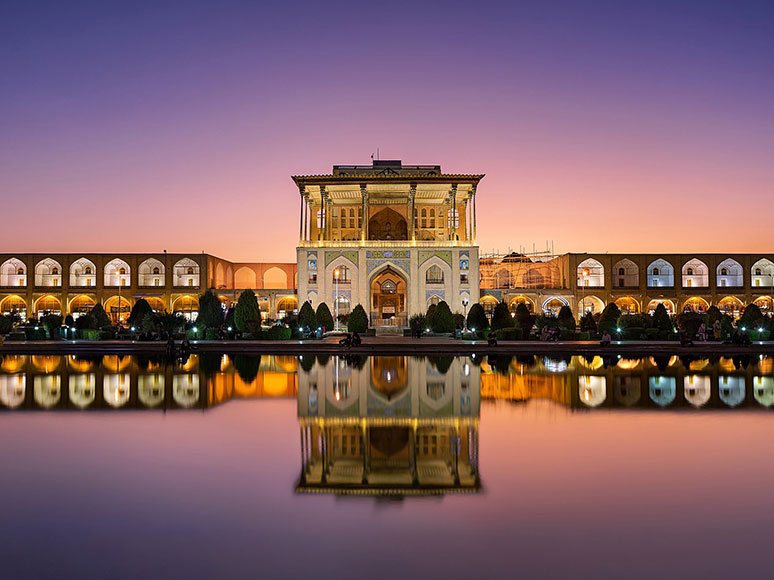
The Great Square of Naqsh-e Jahan in Isfahan is a fundamental and fundamental monument of the fifth Shah of the Safavid dynasty, which was built between 1000 and 1038 AH by order of Shah Abbas.
Naqsh-e Jahan Square in Isfahan
History:
The Great Square of Naqsh-e Jahan in Isfahan is a fundamental and fundamental monument of the fifth Shah of the Safavid dynasty.
This square was built between 1000 and 1038 AH by order of Shah Abbas.
During his reign, due to political problems, especially military conflicts with the Uzbeks in the east and the Ottomans in the west, as well as the geographical location of Isfahan, Shah Abbas decided to move the capital from Qazvin to Isfahan.
After choosing Isfahan as the capital and changing the urban structure of Isfahan towards Zayandeh-rud, creating a square as one of the important indicators of urban architecture of that era became necessary.
Therefore, Shah Abbas ordered his architects to build a large square that would both represent the splendor of his capital and accommodate the growing population of Isfahan.
The square is known by various names:
Shah Square due to the decree of Shah Abbas
New Square in contrast to the old square of the Seljuk era
Naghsh-e Jahan Square due to its construction on the remains of a garden
Today’s Imam Square
According to existing travelogues, the large Naghsh-e Jahan Square in Isfahan was a place for religious ceremonies and national and patriotic rituals, military parades, and the game of polo.
Although polo is no longer played, the polo gates in the form of stone columns are located in the north and south of the square.
Naghsh-e Jahan Square in Isfahan
Specifications:
This square is 525 meters long and 159 meters wide.
It is also considered the second largest square in the world with an area of 835,000 square meters after Beijing’s Tiananmen Square.
Naghsh-e Jahan Square was registered as a cultural heritage by UNESCO in 1979.
The square has a rectangular plan with two axes: west-east and north-south.
It is surrounded by four buildings on each axis, each of which had a special function in its time.
On the western axis, the Ali Qapu Mansion with a government function stands out, and opposite it (the eastern axis) is the beautiful Sheikh Lotfollah Mosque, which was the special mosque of the royal family.
On the longitudinal axis of the square (north-south), on one side is the Qeysariyeh Bazaar with an economic function, and on the other, the Great Abbasi Mosque with a religious function.
Visiting Guide:
Try to set aside half a day to visit this valuable historical monument.
Horse-drawn carriage rides in this square have a special attraction among tourists, and you can ride the carriages around the square.
You can buy a variety of traditional Isfahan foods and souvenirs such as gaz, pulki, calligraphy utensils, enamel work, and calligraphy work from the market around Naqsh-e Jahan.
In Naqsh-e Jahan Square, you can enjoy delicious porridge, doogh, baklava, traditional Isfahan foods, ice cream, and fruit juice.
Access to the square:
Since this square is located in the city center, numerous taxis will take you to this place. Also, if you have your own vehicle, you can go to the square from Sepah Street. You can also walk from Ostandari Street through the alley behind the kitchen and the alleys perpendicular to the square.
For more information about other historical places in the city, click here.