


Fahraj village, Yazd

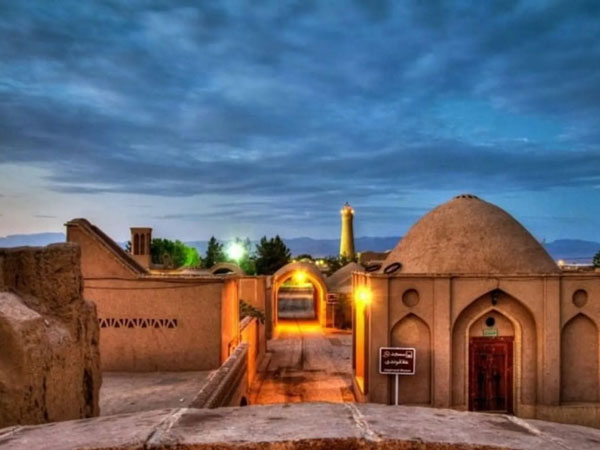
The 5,000-year-old village of Fahraj, Yazd, has many ancient attractions and is located 22 kilometers southeast of the city.
Introduction:
Fahraj Village is a part of the central district of Yazd, 22 kilometers southeast of Yazd and on the Yazd-Bafgh road.
It is said that this village is about 5,000 years old and dates back to the Neolithic period.
Fahraj Village has many ancient and historical attractions.
This ancient village was once one of the four main districts of Yazd and was called Darvaze Isatis.
Brick buildings, roofed alleys, windbreaks, proximity to the desert, and the presence of a clear starry sky are some of the attractions of Fahraj Village.
Fahraj Village, Yazd
Background:
The age of Fahraj Village dates back to before Islam.
According to historical documents, the Arab army lost its way on the way to Khorasan and in the Rig Shatran region. After this incident, they decided to invite the people of Fahraj village to Islam. The people of Fahraj village, with the cooperation of the people of Khoydak and Faraftar villages, ambushed the army of Islam and a war took place in this area.
Due to the location of the village in a desert and remote area, it was called Boreh, Pooreh, Pahra, Fahra and Pahrag, which means a place of wandering.
Fahraj village, Yazd
Features:
This area has a desert climate.
There are 8 deep and semi-deep wells in this village. For this reason, the occupation of most people is animal husbandry, agriculture, gardening and mining.
The products of this village include mung beans, wheat, barley, millet, pistachios, peaches, apricots, grapes and plums.
Fahraj village is the center of Mazafati date production in Yazd province, which is of high quality.
In the past, silkworm breeding and silk fabric production were very popular in this village.
Now, carpet weaving in this village has flourished and its carpets are exported to Bam and Kerman.
Other handicrafts in the village include weaving, spinning, sacking, and tarpaulin.
National and religious ceremonies and festivals in this village are very spectacular. Ceremonies are usually accompanied by playing wind instruments or setar.
One of the attractions of this village is the clothing of the local people. Men wear Yazdi turbans and pachin-like trousers, and women wear colorful cashmere.
Various types of local soups such as barley soup, mash soup, and soup are common foods in Fahraj village.
Fahraj village, Yazd
Village tourist attractions:
There are 102 historical attractions in this village.
Fahraj Grand Mosque:
Fahraj Grand Mosque, also known as Imam Hassan Mosque, is one of the oldest mosques in Iran.
This historical monument dates back to the first century AH and the Sassanid era.
This mosque has two summer and winter nave and a tall clay minaret.
This mosque does not have a porch, mihrab, dome, inscriptions, or tiling.
Fahraj Grand Mosque was registered in the list of national monuments of Iran in 1349.
Fahraj Martyrs’ Complex:
It is a structure made of mud and brick that dates back to the ninth century AH. This complex is the burial place of the martyrs of the Arab War and the people of Fahraj village.
The Martyrs’ Complex is located 2 kilometers from Fahraj village.
This complex used to have a school, which over time has been converted into a khanqah. Now, a large part of it has disappeared over time.
There are 3 courtyards in this complex. In one of the courtyards, there is an old cypress tree and a water tank that supplied the water needed by the village people.
The six-eyed star is located in the middle of the courtyard, which is considered the most beautiful part of the complex. This star is made of a combination of hexagonal bricks and triangular tiles.
The Fahraj Martyrs Complex was registered in the National Monuments of Iran in 1378.
Alaqbandi Mosque and Tekye:
This mosque and Tekye, of which only ruins remain now, used to have very beautiful stucco work in the past.
Fahraj Castle:
This building also dates back to the 10th and 11th centuries AH and was used as a residential and defensive building in the past.
This ancient castle has a small entrance and is located in the residential area of the village with a quadrangular plan.
4 two-story towers for guarding and observation are located in the four corners of this beautiful castle.
Moaz Castle:
This building is the largest brick building in the village left over from the Sassanid era.
This castle has an area of over 5,000 square meters and there were rooms around the castle for the castle’s residents to live in.
Fahraj Husseiniyeh Reservoir:
In the pre-Islamic era, water consecration ceremonies were held next to this reservoir.
A stone inscription in Naskh script is found in this reservoir, the text of which is about the time of the mulberry trees of Husseiniyeh.
This reservoir was registered in the National Monuments of Iran in 2008.
Qavardi or Naderi Pillar:
In ancient times, pillars were built for messaging and guiding roads, and they guided travelers by lighting a fire on top of them.
Qavardi Pillar or Tower is located 35 kilometers from Fahraj village and on the Silk Road.
The Qavardi Mill is one of the desert towers that has survived from the Seljuk era.
Nader Shah ordered the restoration of this tower, and it has stood strong and sturdy for more than 900 years.
The tower is 40 meters high and has more than 45 steps inside.
The materials of this building, like the Bam Citadel, are combined with camel milk, and the building is covered and decorated with bricks.
This mill is one of the works registered in the list of national monuments of Iran.
Chehel Dekhtaroun Well:
During the Arab attack, the Zoroastrian villagers of Fahraj claimed to be Muslims out of fear and turned their fire temple into a mosque. The women and girls of the village threw themselves into this well to avoid being taken as booty.
Fahraj Kalut:
The Fahraj Kaluts are located along the Shahdad Mountains.
These huts were rural huts that have been shaped into caves by weathering, creating an interesting landscape.
Other information:
Address: 22 km southeast of Yazd, village