


Falak-ol-Aflak Castle, Khorramabad

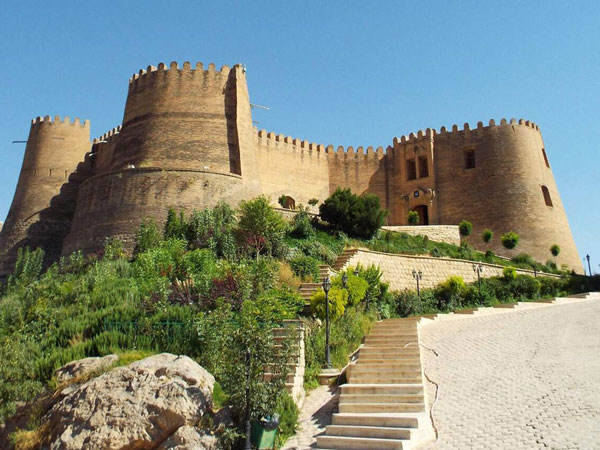
Falak-ol-Aflak Castle is located on a hill overlooking the city of Khorramabad, which is considered one of the most important historical and tourist monuments in Lorestan province.
Introduction:
The historical Falak-ol-Aflak Castle is located near a river in the center of Khorramabad.
This castle dates back to the Sassanid period and is also known as the Twelve Tower Castle.
The word Falak-ol-Aflak means the circle of the stars, which was chosen for the castle during the Qajar period.
The castle was used as a headquarters for various governments from the 4th century AH to the Safavid period.
During the Safavid and Qajar periods, it was also used as a military garrison, and during the Pahlavi period, it was a political prison.
This building was registered in the National Monuments of Iran in 1348.
In 1354, the castle’s use was changed to an anthropological museum.
In recent years, sections such as the Archaeological Museum, the Anthropology Museum, the Laboratory for the Restoration of Objects, the Center for Cultural Productions, and the Traditional Teahouse have been opened in this complex.
The most important features of the building include the location of the castle on rocky cliffs overlooking the city and the fact that the Golestan Spring flows from the northern slope of the hill.
Falak-ol-Aflak Castle, Khorramabad
History:
During the Sassanid period, there was a city called Shapurkhast in the current location of Khorramabad.
It is believed that Falak-ol-Aflak Castle is the same as Shapurkhast Fortress, which had a military function.
After the new city of Khorramabad was located on the ruins of Shapurkhast in the 7th century and then during the Qajar period, the name Falak-ol-Aflak was chosen for the castle.
This castle was restored during the Qajar period by order of Mohammad Ali Mirza – the then ruler of Lorestan and Kermanshah.
A barracks and a courthouse were also built at the bottom of the castle, and the castle became the military headquarters of the Qajar statesmen.
During the first Pahlavi era, the castle was converted into a military garrison and a place to store ammunition and explosives.
After the ammunition was transferred in 1330, the interior spaces of the castle were changed to make it a place to hold political prisoners.
An earthquake in 1338 destroyed the northwest tower of the castle.
In 1348, the castle’s use was changed to the army’s static archive and was registered in the same year on the list of national monuments.
An anthropological exhibition was also opened at the castle site in 1354.
Architecture:
The area of Falak-ol-Aflak Castle is 5,300 square meters and includes 8 towers, 2 courtyards and 300 parapets.
However, based on available visual evidence, until about a hundred years ago, there was a twelve-tower rampart around the current castle building, the remains of which can be seen in the northwest area of the castle.
Many additions have been made to the castle’s architecture over the years, most of which date from the Safavid to Qajar periods.
The height of the highest castle wall to the hilltop is 23 meters, and the castle’s plan is an irregular octagon.
Materials such as adobe, brick, and plaster and lime mortar were used in the construction of the castle.
The entrance to the building is located in the southwest tower, which, after passing through the corridor, connects to the first courtyard.
This entrance is about 10 meters wide and 3 meters high.
The first courtyard is designed with dimensions of approximately 5 x 31 meters and four towers in the north, northwest, south, and southwest directions.
The castle’s bath is located near the well and on the northern side of the first courtyard and was used until the late Qajar period.
The castle’s water well, 40 meters deep, is located in the northeast of the first courtyard and behind a tall arch.
The second courtyard of the building, measuring 21 x 29 meters, has 4 towers and large halls on its four sides.
These halls are currently used as a museum.
The reconstruction of the building with the aim of protecting and restoring this ancient monument was carried out in 2010 by the Cultural Heritage Organization.
The 1.5-magnitude earthquake in May 2010 caused damage to several building congresses and the collapse of some of them.
Falak-ol-Aflak Castle, Khorramabad
Falak-ol-Aflak Museum:
This complex has two museums for public viewing: archaeology and anthropology.
Archeology Museum:
This museum began its activities in 1995 by displaying artifacts discovered from the castle’s historical sites.
However, it was completely closed in 2006 due to the lack of appropriate conservation and technical facilities.
After two years of closure, the museum was reopened in 2008.
There are 12 showcases in this museum, which display an average of 50 historical artifacts.
More than 12,000 historical objects are kept in this museum.
The most important of them are the objects discovered from the Kalmakreh Cave dating back to the Achaemenid period and before.
Anthropological Museum:
This museum started operating in 2002 and has 12 halls.
The Anthropological Museum is a place to get acquainted with the customs and culture of the people of Lor.
The different sections of this museum include wedding halls, occupations and utensils, mourning, performances, music, nomads, native weavings, hunting, bread and a photo gallery.
Other information:
Address: Khorramabad – Imam Khomeini Street – Twelve Towers Street
Castle contact number: 33321895-066
Museum contact number: 33304090-066
Opening hours: Daily from 8:30 AM to 7 PM (Museum is closed on Mondays)
Amenities: Parking – Tourist guide – Information – Shop – Restrooms
Nearby tourist attractions: Inscription stone – Brick minaret – Gabari mill – Shapouri bridge – Stone whirlpool
Have you ever visited Falak-ol-Aflak Castle in Khorramabad? Share your experience with us.
You can get to know other tourist attractions in Khorramabad on Asan-e-Gard.