


Tala wells

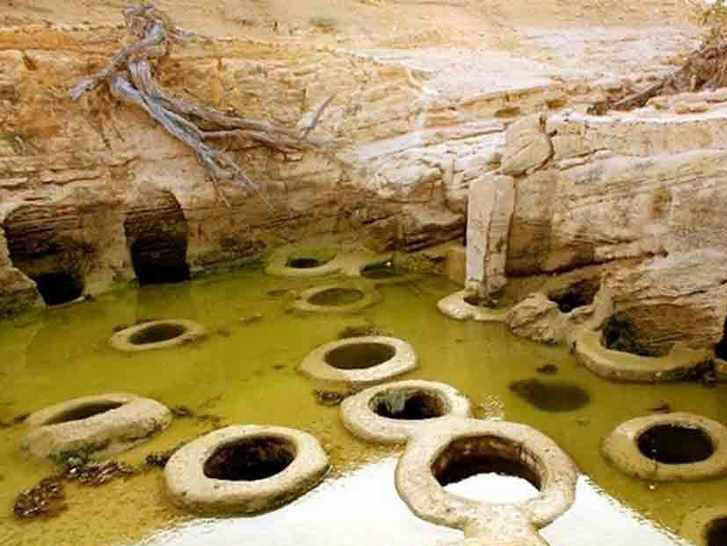
Tala Wells are located in the village of Laft, 70 kilometers from Qeshm city. These wells are located right next to the historical Naderi Castle. In the past, people dug Tala wells in the rock to store water. Tala (which some mistakenly spell as Tala) is an abbreviation for tal-ab, meaning water taken from the slope of a hill.
Tala Wells Tala Wells
Introduction:
The Tala Wells of Bandar Laft, Qeshm Island, were dug in the Sist Kouh rock valley.
These wells were dug in a difficult rock face.
Some of these wells are located at the top of the valley and some inside it.
The wells inside the pit are on average 2 to 3.5 meters deep, and the wells above them are between 5 and 6 meters deep.
The water in these wells is supplied from the water from rainfall and overflow from the tal (hill) upstream.
For this reason, they are known as Tala wells, meaning water mounds.
Some also believe that these wells are referred to as “gold” due to the lack of water in arid areas.
The number of Tala wells is about 50 to 60.
Due to the downward slope of the hills surrounding the pit, these wells have water most of the time.
Unless the wells are filled with mud, in which case they must be dredged.
Water is drawn from Tala wells all year round.
Women and girls draw water with jugs, buckets, and buckets.
Men also draw water with a kandil – a wooden tool with a bucket hung on both sides with a rope and placed on their shoulders.
History:
Tala water wells are based on the water storage technology of the island-dwelling Persians, dating back to the Achaemenid and Zoroastrian eras.
Some believe that these wells were created in 976 AH by order of the then ruler of Bandar Laft, Khajeh Karim.
The wells were dug by slaves to store rainwater and compensate for the water shortage of the people.
It is said that the number of these wells was the number of days in the leap year, i.e. 366.
This number of wells was for daily water withdrawal from each of them until the end of the year.
In the past, most wells were named after their builder. However, the Tala wells got their name from their features and appearance.
In the past, the Tala wells had Mirab, meaning water guardian.
Most of the time, the Mirabs were chosen from among women, especially old Lafti women.
They supervised the water withdrawal. In years of drought, they also tried to distribute water fairly among the people.
Among the last Mirabs that the locals remember are Sharifeh Bashir and Kati Ti.
In the past, the people of Laft village were responsible for cleaning the wells.
In recent years, the late Mohammad Saberpour had made great efforts in this regard.
Two historical monuments, watchtowers from the 17th century, are also located above the Tala wells.
Features:
The Tala wells were registered as one of the national monuments of Iran in January 1998.
The hill or mound overlooking these wells is a coral rock that directs rainwater to the pit.
The roots of several old trees with twisted and thick stems have sunk into the rocks to reach the water. Some people in the region consider these trees sacred and tie green cloths to them. Some also believe that these trees are the guardians of the water wells and their greenery is due to the fresh water in the wells.
The wells have been dug in various shapes such as square, rectangular, circular, etc. There are also wells with names such as Gharaboo, Lubni, Ashouri, etc.
The bottom of the wells is made of gypsum layers so that the water in them remains healthy and cool for a long time.
Other information:
The Tala Wells are located 30 kilometers from Qeshm Airport.
If you enter Qeshm Island through Bandar Pol, you can visit these wells at the Lafteh Pier.
If you have already visited the Tala Wells of Qeshm Island, share your experience with us.
You can also get acquainted with other tourist attractions of Qeshm Island in Asan-e-Gard.