


Tehran Negarestan Museum Garden

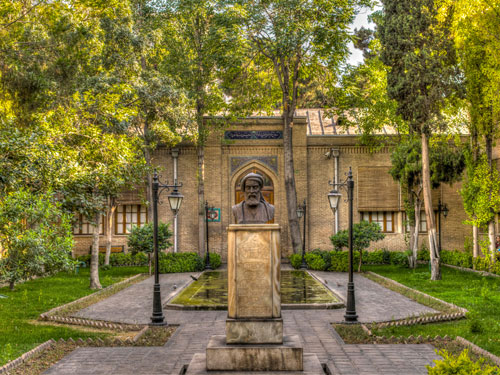
There are many valuable and spectacular museums in Tehran. One of these important museums is the Negarestan Museum Garden. You can see many valuable works of ancient Iran, such as the paintings of Kamal-ol-Molk or the manuscripts of Malek-e-Shoara Bahar or the miniature works of Ostad Esfarjani, etc. in this museum.
Introduction:
- The Negarestan Museum Garden in Tehran is a very beautiful old and historical building.
- It was built by order of Fath-Ali Shah Qajar in 1222 AH as a summer residence.
- This building is built in the pergola style.
- The reason for the name Negarestan Museum Garden is because there are many paintings displayed in it.
- Most of them are portraits. These works were painted by artists such as Mirza Jani Naghash, Abdullah Khan Naghash Bashi and Mirza Baba Naghash.
- This building has 2 buildings named Qalamdan and Delgosha Halls.
- This building has 64 rooms and a library with four halls and four halls.
- The halls are decorated with mirror work, golden designs and chandeliers.
- The area of this building is 600 meters.
- Today, a small part of the palace building and the garden itself have been built by the National Management and Planning Organization and the former Higher Education Institute.
History:
- During the reign of Mozaffar al-Din Shah, a school of arts was built in this garden under the supervision of Kamal al-Molk.
- After that, in 1307 AH, the Minister of Culture designated the Negarestan garden as the permanent location of the Higher Education Institute.
- In one corner of the Negarestan Museum, a building called Hafeziyeh has been built, which reminds visitors of Shiraz and the tomb of Hafez.
- A beautiful polygonal pond and its candelabras at the entrance to the garden make every viewer feel good.
- A pond and a fountain have been built in each corner of the roof.
- There are also other beautiful works, such as a withered tree, which the artist has used to give life to several birds, creating a beautiful and unique scene.
- This garden museum was added to the list of national monuments of Iran on August 1, 1998 and registered as a cultural heritage.
Available places:
- Kamal-ol-Molk School Museum
This museum has more than 130 paintings by this great artist and his students. Most of the works display still lifes, landscapes, and single figures. - Malek-e-Sho’ara Bahar Hall
This museum houses a number of books and photographs of the poet, as well as manuscripts and digital documents of Malek-e-Sho’ara Bahar’s works, which were established by his son Cheherzad Bahar. - Esfarjani Hall
The beautiful works in this collection were donated to the University of Tehran by Professor Ali Esfarjani. They include 18 leather mosaics and miniatures. They are now displayed in one of the halls of the Negarestan Garden. - Jahangir Arjomand Hall
The result of fifty years of efforts by Master Jahangir Arjomand in creating beautiful sculptures is displayed in this hall. It has a great attraction for visitors. Here, all the famous Iranian figures and foreign politicians have been transformed into small sculptures with the art of this master. - Monir Farmanfarmaian Hall
This Iranian artist is the only artist who has used mirror work, geometric shapes, shadow patterns, and painting behind glass in the past 40 years to create her works. Her works have been exhibited in art centers around the world, such as the Museum of Modern Art, the Metropolitan Museum, and the Guggenheim in New York.
Other available places:
- Ferdowsi Sardis
- Mahmoud Ruholamini Collection and Hall
- Fathali Shahi Salam Row
- Negarestan Garden Tile Room
- Museum of Silver Engraving Works Donated by Gholamhossein Melul
- Roohi Restaurant Cafe
Important historical events:
- Mohammad Shah was crowned on the Peacock Throne in this garden.
- It was named as the Ministry of Justice in 1304 AH.
- It was considered as the permanent location of the Teachers’ College and the Higher Education College in 1307 AH.
- Thus, two important faculties of social sciences and literature were established in that place.
- The first Iranian Academy was formed in the Council Chamber of the Higher Education College in 1314 AH.
- The first Falahat School was established in this place during the reign of Mozaffar al-Din Shah in 1318 AH by the Austrian Dasher.
- The Negarestan Garden was given to the Institute of Social Research in 1337 AH.
- The School of Advanced Industries was opened in the Hoz Khaneh building during the reign of Ibrahim Hakim al-Molk under the presidency of Kamal al-Molk in 1329 AH.
- Mirza Abul-Qasim Qaem-e-Maqam, the minister of Mohammad Shah, was killed in the basement of the Delgosha building in this garden in the month of Safar 1251 AH.
- The Institute of Culture and Art was established in Negarestan Garden in 1377 AH.
- This research institute was renamed to the Institute of Culture and Art in 1381 AH.
- The Dehkhoda Dictionary Institute, the Geography Institute, and the Institute of Foreign Languages have continued their scientific activities here since 1335 AH.
Specifications:
- Address: Tehran, Baharestan Square, end of Daneshsara Street, Shariatmadari Street, Negarestan Museum Garden
- Phone number: 021-33119586
- Website: negarestan.ut.ac.ir
- Entrance fee: 5000 Tomans
- Visiting hours: Every day from 9 am to 7 pm except Mondays and mourning days
Tehran’s Negarestan Museum Garden is one of the most valuable and spectacular museums in Tehran. It contains many old and ancient works of Iran. You can also visit several separate museums by visiting this museum garden complex.
If you have visited this place before, please share your experience with other Easy Tour users.