


Kharanagh village, Yazd

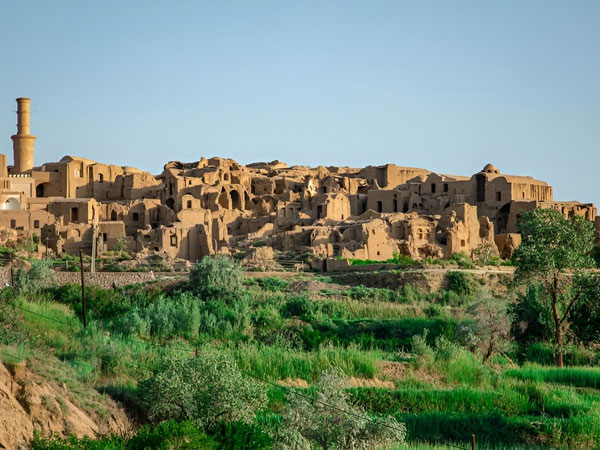
Kharanaq Village, Yazd
Kharanaq Village, Yazd, known as the birthplace of the sun in Iran, is about 4,500 years old.
Kharanaq Village, Yazd
Introduction:
Kharanaq Village is one of the oldest villages in Iran, dating back 4,500 years.
Kharanaq Village is located 85 kilometers from Yazd city, in a mountainous area, near Ardakan County.
This village has two parts, the new and the old, which is now the place where the villagers live.
Kharanaq Village, due to its age, is considered one of the historical treasures of Iran and has many historical attractions.
Kharanaq Village is particularly popular among tourists, especially European tourists.
Kharanaq Village is also known as the birthplace of the sun in Iran.
The best time to travel to Kharanaq is spring, autumn, and winter.
History:
The old name of this village was Khoranq or Khoranq, which comes from the word Horneh, meaning the rising of the sun or the birthplace of the sun.
The oldest historical document in which the name of the village of Kharanq is included is from the year 24 AH and the era of the Sassanid Yazdgerd government.
A Zoroastrian monk mentioned the village of Kharanq in this document as a resting place and caravanserai for merchants and travelers.
Kharranq village, Yazd
Features:
The main occupation of the current residents of the village is the cultivation of wheat, carrots, melons, barley, cotton, and agriculture or gardening.
Activities such as animal husbandry and carpet weaving are also observed among the people.
Despite the problem of water shortage in this area, the village of Kharanq has rich and valuable soil.
Valid mines of uranium, granite, barite, iron ore, and zinc are located around this village.
Despite the desert nature of the area, there is a mountain next to Kharanaq village, which moderates the air and adds greenery to the area.
Summers in Kharanaq village are about 10 degrees cooler than in Yazd city, and this village has cold winters.
Plants such as agarwood, safflower, thyme, mountain almond, and wild fig can be seen in this village.
The area around Kharanaq village is home to animals and birds such as cheetahs, wild cats, rams and ewe, goats, rabbits, foxes, turtles, pheasants, jays, partridges, and various birds of prey.
Beautiful nightshades woven by the women of the village, and pistachios and apricots are considered souvenirs of Kharanaq village.
Kharanaq Village, Yazd
Tourist Attractions:
Now we will examine each of the tourist attractions of this village:
Kharanaq Castle
In the past, Kharanaq Village was very much targeted by thieves and bandits. For this reason, the residents of the village built Kharanaq Castle to stay safe.
Kharanaq Castle is one of the oldest and largest residential castles in Yazd province, which now forms the old part of the village.
The area of this castle is about 1 hectare, in which there are 80 houses with one, two, three and even four floors.
There are structures in Kharanaq Castle that are 1800 years old.
This castle has been uninhabited for about three decades.
The houses in this castle do not have courtyards and are made of brick and mud.
Kharanaq Castle is located on a hill for complete nobility, and ditches were dug around it.
There are 6 guard towers and 4 entrance and exit gates in this castle, and the path inside the castle is narrow and winding.
The historical castle of Kharanaq village was registered in the list of national monuments of Iran in 2004.
Kharanaq Bath
The Kharanaq Bath is a remnant of the Qajar era.
This bath is located in a caravanserai and near agricultural fields.
The clever design of the water inlet and outlet system is one of the masterpieces of this building. In such a way that the water from the aqueduct flows into the bath and the sewage is directed towards the agricultural lands.
The walls are made of very thick bricks, and there are also openings in the roof of the building that direct light inside.
All the elements of an Iranian bath, including the entrance, vestibule, dressing room, doorway, and hot tub, are present in the Kharanaq Bath.
The Kharanaq Bath was registered in the list of national monuments of Iran in 2009.
Kharanaq Caravanserai
The original construction of Kharanaq Caravanserai dates back to the Sassanid era.
This caravanserai was renovated and rebuilt during the Qajar era by order of Vali Mirza (son of Fath Ali Shah) and became a popular resort.
This caravanserai consists of a courtyard and the surrounding rooms and courtyards. The current building style was described by Shah Abbasi.
Kharanaq Caravanserai consists of 4 pavilions, each of which includes a large porch and several smaller porches around it.
The beautiful brickwork, plasterwork, and tiling used in the construction of this building give it a special beauty.
This building has recently been renovated and is now used as a place to stay for desert travelers and tourists.
Kharanaq Caravanserai was registered in the list of national monuments of Iran in 1377.
Kharanaq Aqueduct Bridge
The aqueduct bridge or aqueduct was built to transfer water from one side of the river to the fields and farmlands on the other side.
There is disagreement about the time of its construction, but some attribute it to the Parthian era.
The aqueduct bridge is about 40 meters long and 7.5 meters high.
Masonry and mortar are the main materials used to build this bridge.
The aqueduct bridge has 4 arched openings in the Roman style, made of plaster and stone.
Jame Mosque and Hosseiniyeh of Kharanaq
These two buildings are located in the center of Kharanaq Castle and date back to the Qajar era.
These two buildings are made of brick and mud and were registered in the National Monuments of Iran in 1378.
The Shaking Tower
The Shaking Tower is an all-brick minaret located inside the castle.
This minaret was built during the Sassanid period and completed during the Seljuk period.
This minaret is older than the minaret of Isfahan and is moved by force.
The minaret of Kharanaq has three floors and two spiral staircases, the width of which decreases as you go higher.
This minaret