


Marble Palace and Caspian Observatory Museum, Ramsar

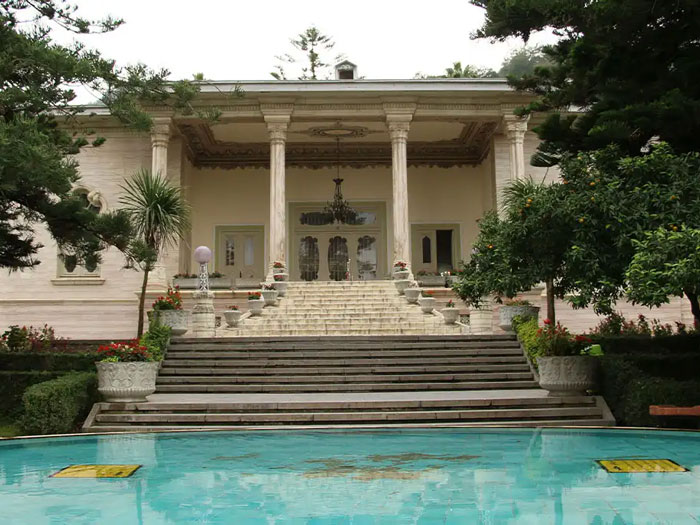
The Ramsar Marble Palace or the Khazar Museum is one of the most exquisite historical sites in the city, dating back to the first Pahlavi era.
Introduction:
The Ramsar Marble Palace was built in 1316 by order of Reza Shah Pahlavi.
This palace served as the residence of the royal family until the Islamic Revolution of 1357.
The reason for its name is due to the extensive use of marble in its construction.
The palace building is located in a 6,000-meter garden where the first modified citrus seedlings and other rare ornamental plants have been planted.
The works on display in the palace museum include antique buffets, furniture, candlesticks, crystal, archaeological finds, Persian carpets, exquisite bronze and marble sculptures, and paintings by world-famous artists.
These works are located in the halls of human and non-human decorations, the Hall of War Weapons, the Elephant Hall, the Furniture Hall, and the Decoration Halls 1, 2, and 3.
The building of this palace and its surrounding buildings were registered in the list of historical monuments of Iran in 1378.
Marble Palace and the Caspian Sea Watch Museum in Ramsar
History:
The construction of this palace began on the orders of Reza Shah and was completed in 1316.
This palace-museum hosted Reza Shah for only 4 years, and then became the resort of Mohammad Reza Pahlavi until 1357.
Of course, Mohammad Reza Shah’s classmate, a person named Ernest Perron, who was skilled in gardening, stayed in this palace for a while.
After the Islamic Revolution of 1357, the palace became the property of the Foundation for the Oppressed of the Islamic Revolution and was unused for 21 years.
Until it was renovated and restored in Ordibehesht of 1378.
Then, in March 2000, the Caspian Watch Museum was reopened to display artifacts belonging to the palace and research on artifacts related to the Caspian Sea basin.
In 2011, the Caspian Watch Museum achieved the highest growth in visits among museums in the country.
Also, in 2012, the World Children’s Day ceremony was held here, and in February of the same year, the “Ramsar Through Time” exhibition was held on the topic of the changes and developments of this city and displayed 150 photographs and documents.
Marble Palace and the Caspian Watch Museum of Ramsar
Architecture:
Now we will examine the architecture of the different parts of this historical place:
Marble Palace:
This palace was built under the management of engineer Hovhannes Onik Gharibian and in collaboration with Iranian and German architects.
This building is rectangular in shape, with a hall in the east-west direction and a central hall and 2 large rooms with bathrooms and toilets on the sides.
The floors of the rooms are parquet and the doors and windows are made of wood.
The facade of the palace is made of Mashhad veined onyx marble with a diameter of 30 cm.
About eleven steps are located in the main (northern) entrance of the palace.
These steps decrease in width from bottom to top, which gives a special look to the facade of the palace.
At the northern entrance, 4 marble columns with a height of 10 meters are used, whose crowns and bases are carved and their bodies are seen in the form of 8 semicircular arches.
Beautiful stucco moldings in the shape of animals and human faces have been used to decorate the ceilings, sides of the hall and the spaces between the walls.
The hall and rooms have fireplaces whose firebox is made of cast iron, fire grates and its surroundings are made of brass, which are decorated with stucco of flowers and plants.
Another entrance is located in the southern part of the palace, on both sides of its stairs, there are two sitting tigers made of Torbat Heydariyeh marble.
These sculptures were made by Master Rahimzadeh Arzhangi and installed by Master Hossein Lorzadeh.
There is also a basement in this palace that is not open to the public and its roof is covered with beams to prevent damage due to earthquakes.
Other buildings:
Five other buildings, including a bathroom, a storage room, facilities, a caretaker’s office, and a guardhouse, are also located in the garden.
The old bathroom of the palace was put into operation during the reign of Reza Shah, then in 1320 a new bathroom was built inside the palace.
The old bathroom includes sections of the cold and hot water treasury, the Sarbin pond, and…
The heating source of this bathroom is a wood-fired fire.
Its water was also supplied from the southwest spring of the compound.
The palace’s storage room has now become a place to sell handicrafts.
Garden:
In the garden of the Marble Palace, there are about 1,800 citrus trees, 300 kiwi trees, and trees such as pine, cypress, and palm trees are the most abundant.
The tea garden, the cowslip flower garden, and the bamboo garden are also considered other parts of the garden.
The names and species of trees and plants in this garden are marked with placards.
A 23-meter-high pine tree is located in front of the palace, which was planted in 2013.
This pine, known as the four-branched pine, is more than 1.5 meters thick.
There is also a circular pond in front of the palace, decorated with a number of caviar fish.
This garden is considered the second place in Asia and the first in the Middle East to have seen the naked plant.
The naked plant is one of the most primitive plant species in the world, dating back about 400 million years.
The plant Psyllium nodum, which is found only in the Americas and Japan, is grown in this garden.
The design of the garden’s paths is not straightforward.
Rather, the entrance is in the form of a spiral (known in architectural terminology as the Iranian veil) from the east and west.
These paths are covered with sand and decorated with boxwood and various flowers.
Other information:
Address: Ramsar, Enghelab Square, Shahid Rajaee Street, next to Ramsar Hotel
Contact number: 011-55225374
Opening hours: Every day from 9 am to 5 pm (except public holidays)
Have you ever visited the Marble Palace and the Caspian Watch Museum in Ramsar? Share your experience with us.
You can get to know other tourist attractions in Ramsar on Asan-e-Gard.