


Qeshm Salt Salt Cave

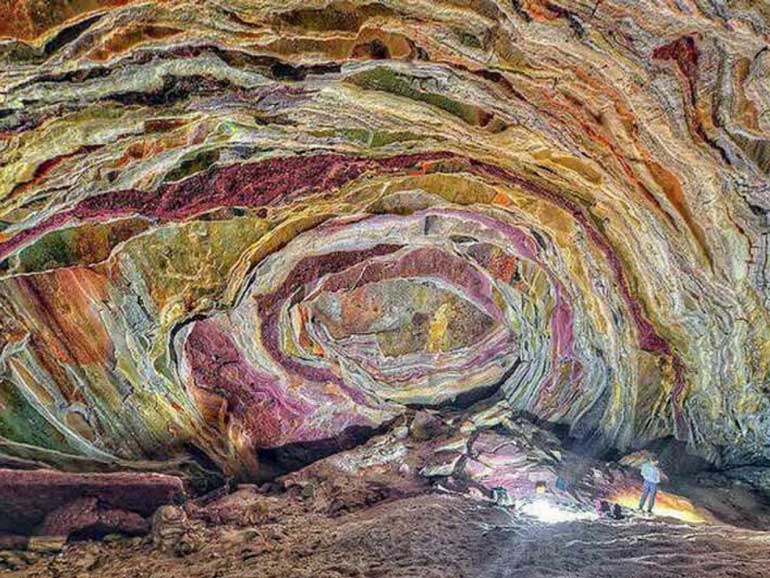
Qeshm Salt Cave
Qeshm Salt Cave is one of the natural attractions of the island and is located 90 kilometers from Qeshm city. This cave is also known as the Salt Cave and the Cave of the Three Naked Men. The Salt Cave is the longest salt cave in the world. The approximate length of the cave is estimated to be about 6600 meters. However, due to the impassability of some parts, its final length is expected to be longer than this. The salt extracted from this cave has many edible and medical uses.
Qeshm Salt Cave
Introduction:
The Salt Cave is located in the southwestern part of Qeshm Island.
This cave is located in a dome-shaped mountain at an altitude of 237 meters above sea level.
This cave, with its white salt veins, presents a unique and snowy landscape.
The Salt Cave is located 2 kilometers from the neighboring beach, which is recommended to be walked.
In addition to edible consumption, the salts extracted from this cave have medicinal uses.
This salt contains magnesium and is prescribed in capsule form to professional athletes.
Inside the cave and deep inside it, there is not enough light to see the salt crystals, and strong and bright flashlights are needed.
The ceiling of the cave is covered with salt crystals and marble icicles.
The humidity of the air and the penetration of water cause saturated salt water to drip from the ceiling and form icicles.
There are salt water streams on the floor of the cave. In the heart of the Namakdan cave, this underground water stream is present, which opens the way out of the cave.
A natural pond in the heart of the cave has also caused a salt spring to form on the mountainside.
This spring flows all year round and its main bed is red.
The reason for its red color is the presence of ochre or refractory clay deposits in it.
Iron oxide deposits, especially hematite, are also present in this area.
The salt layers of the Namakdan cave have risen over time and are affected by buoyancy.
These layers are formed above the surrounding rocks due to their lower bulk density.
History:
Namakdan Cave was discovered by Czech geological engineers in collaboration with Shiraz University in 1998.
They visited 16 salt domes.
The result of this project was the discovery of 60 caves and the mapping of 30 of them.
They mentioned Namakdan Cave as the most amazing and attractive salt caves.
After this discovery and globalization of Namakdan Cave, it was registered as a UNESCO Geopark in 2006.
The story of naming the cave after the three naked men is as follows: three experts from the Czech Republic enter the cave to explore and map it. Deep in the cave, they reach a point where they have to swim through thick salt water to continue their journey. They knew that swimming in salt water, due to the presence of sediments, will make their clothes stiff and immobile. Therefore, they put their clothes on a piece of wood and continued the cave path completely naked and mapped it. For this reason, they named the cave after the three naked men.
According to studies by researchers at Shiraz University, the age of the cave salts dates back to the pre-Canberran period, about 570 million years ago.
However, the emergence of salt domes is a younger phenomenon and is about 6,000 years old.
Namakdan Cave, Qeshm
Features:
Namakdan Cave was registered in 2006 as part of the UNESCO-supported geoparks.
This cave was registered in the Natural Heritage List of Iran in 2011.
After half an hour of walking in Namakdan Cave, we reach a place where it is impossible to continue the path without mountaineering equipment.
The presence of small insects in the cave may be a bit annoying, and the sounds of bats can also be heard.
Breathing in the cave air has medicinal properties and is recommended for asthma and respiratory patients.
Visiting the Chahkouh Gorge and Namakdan Cave can be included in a day’s program. Because these two tourist attractions are located in the heart of each other.
Other information:
Visiting this cave requires a guide who is fully familiar with the route.
There are two routes to reach Namakdan Cave.
The first route, which is a little longer but smoother, is the route from Rousai Tabol to Basaidu. After passing through the village of Basaidu, the Namakdan Cave guide sign shows a side road. This side road is the highway.
The second route, which is closer, passes through the village of Salkh. By moving towards Qeshm Airport and passing through it, we reach the village of Salkh. After passing through the village, we continue the route and we can reach Namakdan Cave. A large part of the second route is the highway.
You can get acquainted with other tourist attractions on Qeshm Island in Asan Tour