


Saadi’s Tomb

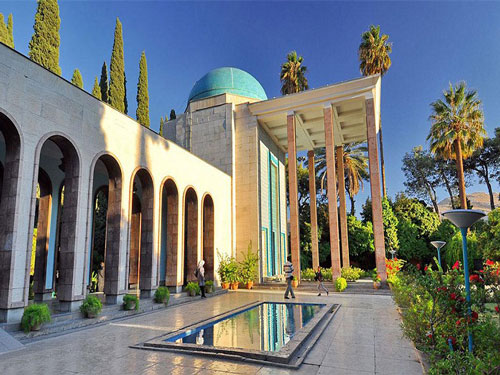
One of the historical and touristic places in Shiraz that is of interest to people of literature and art is the tomb of the master of speech, Saadi Shirazi.
Introduction:
Saadi’s tomb is located on Bostan Street in Shiraz and on the slopes of the mountain.
Saadi Shirazi is known all over the world and his poems have been translated into various languages.
For this reason, many domestic and foreign tourists visit this beautiful tomb every year.
The location of Saadi’s tomb next to the Delgosha Garden has caused the scent of oranges to fill the tomb, especially in the month of Ordibehesht, and has brought a unique atmosphere.
In addition to Saadi, there are graves of many religious figures in this tomb who were buried there according to their wills.
In 1974, this building was registered in the list of national monuments of Iran.
The entrance to the tomb, designed by Frenchman André Godard, features a beautiful poem:
From the soil of Saadi Shiraz, the scent of love comes a thousand years after his death.
Saadi’s Tomb
History:
The place where the tomb is now located was the Khanaqah of Saadi and his disciples during his lifetime.
Saadi lived in this place for the rest of his life and was buried there.
For the first time in the 7th century, about half a century after Saadi’s death, Shams al-Din Muhammad Sahib Diwani built a tomb over Saadi’s tomb.
According to a writing by Ibn Battuta, which dates back 57 years after Saadi’s death, people at that time washed their clothes in the water of the tomb’s ponds and believed that this water was holy.
In 998, on the orders of Yaqub Zulqadr, the entire building was demolished.
Several years later, during the Zandi era, and by order of Karim Khan, a building was built of plaster and bricks for the tomb.
On the lower floor, there was a corridor with two rooms.
Saadi’s grave was located in a room in the eastern part.
Later, in the room in the western part, Shorideh, the blind poet of Shirazi, was buried.
During the Qajar era, this building was first destroyed due to religious differences and then restored by Fath Ali Khan.
In 1324, the National Monuments Association was formed with Professor Ali Sami as a member and secretary.
At the same time, proposals were made to revive the Saadi monument.
In 1325, steps were taken for this.
However, serious steps were taken from 1327 with the efforts of Ali Sami and Ali Asghar Hekmat, who was the head of the National Monuments Association of Iran at that time.
Engineer Mohsen Foroughi and Engineer Ali Sadeq presented the current design of Saadi’s tomb in 1328.
This building, with a design inspired by the Chehelsotun Palace and authentic and modern Iranian architecture, was completed in 1330.
On May 11, 1331, Saadi’s tomb was inaugurated in the presence of Dr. Mahmoud Hesabi, who was the Minister of Culture at the time.
Saadi’s Tomb
Architecture:
The tomb is located in an area of about 104,000 square meters.
In the middle of the courtyard, there are two rectangular ponds in a north-south direction and on both sides of the tomb, and another pond with an east-west direction is located in front of the main porch.
The L-shaped building of the tomb includes a porch and a long, perpendicular portico with blue and turquoise tiling in a dreamy and beautiful garden, creating an eye-catching view.
In front of the tomb, there is a porch with 8 columns made of brown stones.
The tomb, decorated with white stones and tiles, looks like a cube from the outside, but it is octagonal from the inside.
Around it and in the 7 corners of the building, there are seven calligraphy inscriptions on which Saadi’s poems are inscribed.
Above the tomb is a dome covered with turquoise tiles.
The tombstone is located in the middle of the octagonal building, and marble walls surround the tombstone.
This tombstone was installed by Ali Akbar Khan Qavam al-Molk Shirazi, which has an inscription of Saadi’s poems on it.
On the left side of the tomb, there is a portico with 7 arches that ends with the tomb of Shorideh Shirazi, a poet of the Safavid era.
On the door of the room, there is an inscription introducing the poet and inside the crimson tiles decorated with the poet’s poems.
There is a beautiful pond in front of the porch where people throw coins into to relieve themselves.
A beautiful octagonal fish pond is located near the tomb and to the left of it, and its water is supplied from a spring that flows from under the building.
Other information:
Every year on the first of Ordibehesht, a ceremony commemorating Saadi is held in this tomb.
Address: End of Bustan Street, next to Delgosha Garden
Visiting hours: 8 am to 9 pm
Ticket price: Iranian tourists 5,000 Tomans – Foreign tourists 50,000 Tomans