


The two minarets of Dar al-Ziafeh in Isfahan

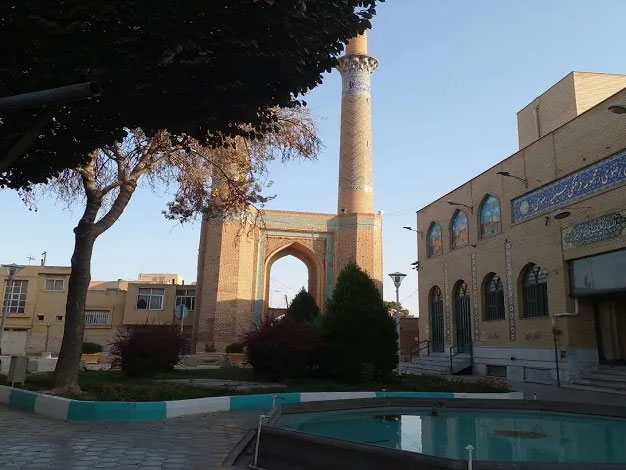
The two circular minarets of Dar al-Diyafa in Isfahan, decorated in the Mughal style and 38 meters high, are located in the Jewish quarter of Jubareh.
Introduction:
Location: Hakim Street – Haj Kazem Alley
Date: First quarter of the 8th century AH during the time of “Oljaito Ilkhanids”
The two minarets of Dar al-Diyafa in Isfahan
Reason for naming:
It is not possible to determine with certainty the reason for naming it.
If the name “Dar al-Diyafa” is the real name of the minarets, then the ruined building was a guesthouse and also had a mosque, and the minarets belonged to that mosque.
But if the name “Dar al-Diya” is correct, then the minarets were for lighting and fires were lit on top of them at night so that the city could be seen from afar.
Another possibility is that the builder of the minarets and the building itself was a person named “Diya”.
Architecture and Decorations:
The minarets have tile decorations and it seems that they were the entrance of a luxurious caravanserai.
These minarets belonged to a king or emir in the 8th century AH (Ilkhani period).
It seems that in the place of the alley, there was a mansion in the past to which the two minarets were connected.
This mansion has been destroyed over time.
The remains of its magnificent entrance, which is above the minarets, largely confirm this statement.
Because its inscription has been destroyed and nothing remains except for one or two sentences.
The minarets are built on wide octagonal bases and are about 30 meters high.
The Muqarnas inscription above the minarets was in white mosaic script on azure tiles.
Of its inscription, only the word “Man Dakhla” remains and part of a verse can also be seen.
Considering the writing of the verse, the assumption that there was a mosque at the site becomes more obvious.
Inside the minarets’ mogharnas, each lily or tas contains a word written in white mosaic script on a lapis lazuli tiled background: “Muhammad”, “Ali”, “Fatima”, “Hassan”, “Husayn”.
The decorative covering of the minarets is also in turquoise masonry script on a brick checkered background in 7 rows as follows: the first row is the word “Allah”, the second row is the repetition of “Akbar”, the third row is the repetition of “Allah Akbar”, the fourth row is the repetition of “Muhammad”, the fifth row is the repetition of “Wa Ali”, the sixth row is the repetition of “Wa Hasan” and the seventh row is the repetition of the word “Wa Husayn”.
The two minarets of Dar al-Ziafeh in Isfahan have been registered with number 272 on the National Heritage List of Iran.
You can get to know other tourist attractions in Isfahan on Asan Gard.