


Tomb of Hafez

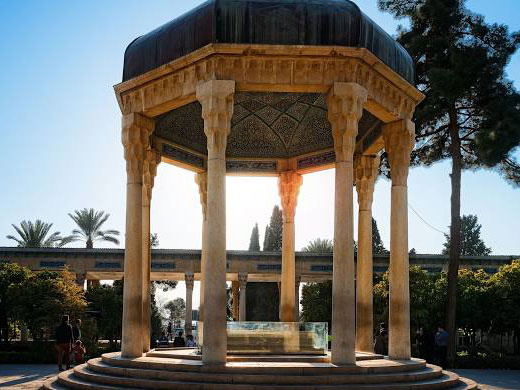
Khwaja Shams al-Din Muhammad ibn Baha al-Din is a famous Iranian poet who died in 792 AH. The tomb of Hafez or Hafeziyeh is one of the most famous historical sites in Shiraz.
Introduction:
Khwaja Shams al-Din Muhammad ibn Baha al-Din is the full name of Hafez Shirazi, one of the famous Iranian poets.
Hafez died in 792 AH.
The tomb of Hafez or Hafeziyeh is one of the most relaxing historical sites in Shiraz.
The green space and unique architecture of the tomb of Hazrat Eshgh have created a poetic and romantic atmosphere for lovers and poets as well as tourists.
You can walk around the tomb and become attached to Hafez’s poems and enjoy seeing the groups of poets and Hafez reciters and smelling the scent of spring oranges and become intoxicated.
Hafez had predicted in his poems that his tomb would become a place of pilgrimage in the future:
On our tomb, as if passing by, the desire of the world will be the pilgrimage site
The tomb of Khwaja Hafez Shirazi is located in the north of Shiraz, below the Quran Gate.
In addition to Hafez’s tomb, this beautiful and unique complex also contains the tombs of some prominent Shirazi families and the tombs of some contemporary Persian celebrities.
In 1975, this building was registered in the list of national monuments of Iran by the Ministry of Culture and Art.
Hafez’s Tomb
History:
The place where Hafez’s tomb is now located was called “Musla” in the past.
This place has long had a special sanctity for the residents of Shiraz and its surroundings.
Sometimes they held congregational prayers and Eid al-Fitr prayers there.
People also sometimes buried their dead in this place.
Hafez’s tomb is also located in the north of this area.
Ovadi Baliani is the first person to name Hafez’s tomb Hafez as Hafez’s tomb.
About 65 years after Hafez’s death, in 856 AH or 1452 AD, the Timurid governor of Fars ordered his minister, Shams al-Din Mohammad Yaghmaei, to build a dome-shaped tomb over Hafez’s tomb.
Hafez’s tomb was renovated and restored several times by the governors of Fars and the Safavid, Afshar, and Zand rulers.
But the last major step was taken in 1314 AH and 1935 AD, during the Pahlavi era, by Ali Asghar Hekmat.
The new plan was designed by Andre Godard, a French archaeologist, and implemented by Ali Raazi, the head of education in Shiraz, and Ali Sami, his supervisor. The implementation of the plan lasted until 1317.
Hafez’s Tomb
Architecture:
Hafez’s tomb, with an area of about 2 hectares, has two northern and southern sections.
These two parts are separated by a 56-meter-long porch with 20 stone columns 5 meters high.
The 4 main columns of the porch were added during the time of Karim Khan and 16 more columns were added during the Pahlavi period.
In the northern area, there are orange trees and two large and beautiful ponds.
In the tomb of Hafez, a building in the shape of a pergola was used, which was widely used in the architecture of the ancient Iranian monarchy.
The 8 columns in the tomb are both a symbol of the 8 gates of heaven and a sign of the 8th century in which Hafez lived.
The tombstone is located one meter above the ground, surrounded by 5 circular stairs.
The marble slab above the tomb was also placed on the orders of Karim Khan Zand.
On this stone, two of Hafez’s ghazals are written in Nastaliq script by Haji Aghasi Beg Afshar Azarbaijani.
In addition, beautiful poems by Hafez are used for decoration on the walls of the tomb.
Under the dome, seven-color mosaic tiles, decorated with the Thuluth line, are tiled.
Other information:
Many cultural activities, including poetry readings, concerts, Hafez studies classes, and traditional music classes, are also held here.
Address: Shiraz, between the Literature Crossroads and Hafeziyeh Crossroads
Visiting hours: 8 am to 10 pm
Ticket price: Iranian visitors 5,000 Tomans – Foreign visitors 50,000 Tomans
You can get acquainted with other tourist attractions in Shiraz on an easy tour.