


Isfahan Shia Mosque

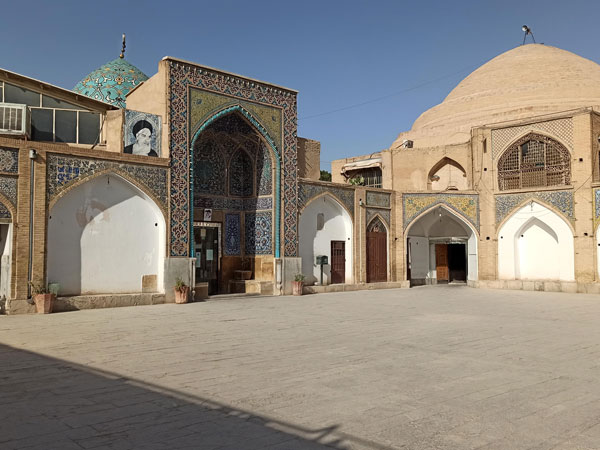
The Shia Mosque of Isfahan is located next to Imamzadeh Ismail, and some books state that this tomb is related to “Shi’a the Prophet”, one of the prophets of the Jewish people (the Children of Israel).
Introduction:
Location: Imam Ali Square – Hatef Street – located in Imamzadeh Ismail
Date: Seljuk – Safavid
Architecture:
A gate from the shrine of Imamzadeh Ismail leads to the tomb of Shi’a.
On the north side of this space is the mosque building, which consists of a porch and a nave.
The current building is built of bricks in the form of a prism and covered with plaster mortar.
A wooden shrine is located inside the building and its dimensions are about 1.70 meters high and 1 meter wide.
The plaster tomb of Shi’a has 6 sides and is approximately 1.6 meters high.
The minarets and brick arches of this tomb date back to the Seljuk period.
Decorations:
Inside this building, various inscriptions can be seen, each of which is written in relief with different scripts such as Nastaliq, Kufic, etc. and contains ancient stories and tales.
On the eastern side, the portico and tomb of a small mosque can be seen, which was originally a mosque from the Seljuk period.
This mosque was decorated with tiles and plaster decorations during the Safavid period, and its altar is made of marble.
Of the remains of this Seljuk-period mosque, only the minaret remains, the rest have been destroyed.
Also, in this mosque, an inscription is written in the Thuluth script and in gold color on a seven-colored tiled background in the northern part, on which verses 18 and 19 of Surah At-Tawbah are beautifully engraved.
The Shia Mosque has various decorations in the porches, the altar, and especially the southern porch.
All of these decorations play a unified and beautiful role in its splendor and uniformity.
Inside the altar, on the left and right sides, there are tiled slabs with white third lines on a background of azure brick tiles.
On these slabs, parts of Surah Al-Imran can be seen on the left side.
The nightstand of this mosque has also been restored.
The name of the founder of this building, “Mohammad Hadi Kashani”, is carved with stucco on the inscription inside the altar and in third line.
The Shia Mosque, attributed to one of the prophets of the Children of Israel, is a sign of the Jewish settlement of Isfahan in the past and is important for those interested in the history of religions.
You can get acquainted with other tourist attractions in Isfahan on Asan Gard.