


Seyyed Mosque of Isfahan

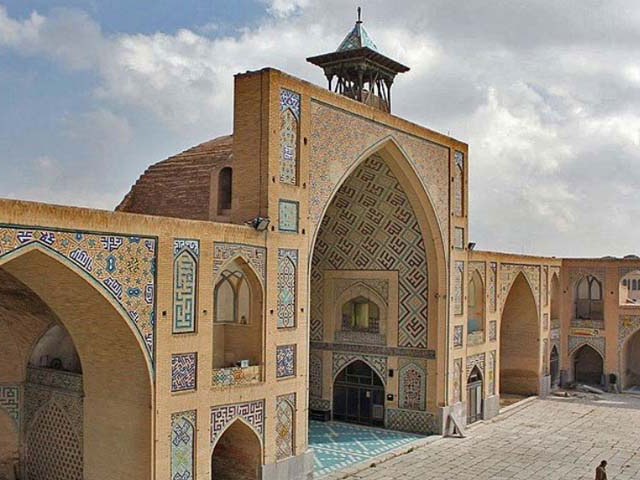
Isfahan is the cradle of Iranian culture and civilization. The historical and religious monuments of Isfahan are famous for their architecture and decorations. One of these valuable monuments and masterpieces of the Qajar era is the Seyyed Mosque of Isfahan.
Introduction:
The Seyyed Mosque is one of the most valuable historical monuments of the 13th century AH, which has been extensively studied in terms of tile art and architecture. The area of the Seyyed Mosque is about 8,000 square meters.
History:
The land of the mosque was purchased during the Safavid era to build a mosque there, but this was not done due to the Mongol invasion.
Between 1245 and 1249 AH, during the reign of Mohammad Shah Qajar, Hajj Seyyed Mohammad Baqir Shafti Rashti, one of the great scholars of Isfahan, built the Seyyed Mosque of Isfahan on the same land.
This mosque is one of the magnificent mosques of the Qajar era.
Parts of the mosque, such as the northern porch, were added to the building by the Seyyed’s children about 50 years after his death.
In its early years, this mosque was a place for various businesses such as Yazazi, carpentry, and coffee houses, and a place for scientific, literary, and political meetings.
Seyyed Mosque of Isfahan
Architecture:
This mosque has two large nave, a dome, two 40-columned columns, two moon-shaped columns, a porch, and a spire.
There is no minaret in this mosque.
45 rooms on the upper floor of the mosque were intended for the residence of students.
There are 3 southern, eastern, and western porches in this mosque. The southern porch is located under the dome and in front of the nave. The eastern and western porches are located in front of the winter nave of the mosque.
The tomb of Seyyed Mohammad Baqer Shafti is located in the northeastern part of the mosque with beautiful decorations.
On both sides of the large entrance of the mosque, there are platforms consisting of 7-colored tiles and flowers and bushes.
The bright red color plays a major role in the tile decorations of the Seyyed Mosque, like other mosques of the Qajar era.
The inside of the dome is covered with decorations such as stucco, mirror work and gold work.
The mosque’s shrine is decorated with silver and gold lines and is considered one of the most spectacular parts of the mosque.
Many inscriptions are placed above the entrances of the mosque. According to these inscriptions, the construction of the mosque took about 130 years.
Verses from the Quranic surahs are written in white and yellow script on the azure background of the door and porch.
The mosque’s mihrab is one of the most magnificent mihrabs left in Islamic art.
The entire surface of the mosque’s courtyard is paved with regularly cut stones.
There is a building called the Hojjat al-Islam Shafti Teaching Hall in the mosque, which seems to have been inspired by the forty-pillar building. Of course, this building consists of nine columns and has wooden columns, doors and beautiful sash windows.
Seyyed Mosque of Isfahan
Specifications:
Address: Located in Bidabad neighborhood of Isfahan
Visit hours: From 9 am to 8 pm
Read complete information about the historical monuments of Isfahan in Asan-e-Gard.