


Moghadam House and Museum, Tehran

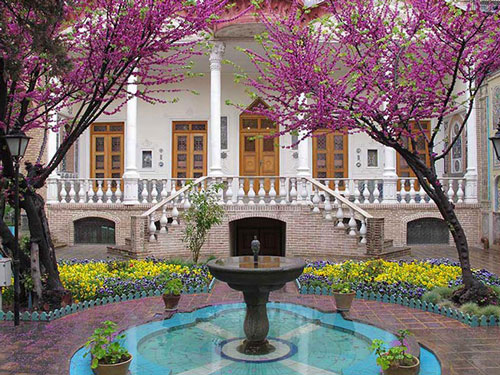
There are many valuable and interesting museums in Tehran. One of these important museums is the Moghadam House and Museum.
Introduction:
- The beautiful mansion of Moghadam was built in the late Qajar period.
- This beautiful, large and magnificent mansion was the residence of Mohammad Taghi Ehsab-ol-Molk, a Qajar courtier.
- At that time, he was the head of the Tehran Ehsab-ol-Molk administration and the Iranian Minister of Mukhtar in Bern, Switzerland.
- He had two sons, one of whom, Hassan, died young.
- The famous play “Jafar Khan from Farang Amdeh” is left behind by him.
- Later, this mansion was owned by Ehsab-ol-Molk’s younger son, Mohsen Moghadam, who was one of the founders of the Faculty of Fine Arts at Tehran University and also a distinguished professor of archaeology at Tehran University.
- Dr. Mohsen Moghadam lived in this house with his wife Salma Koyu Majian, who was born in Bulgaria and was the head of the library of the National Museum of Iran.
- In addition to his scientific activities, he has started collecting various works of tiles and stone pieces with the aim of preserving cultural and historical works.
- He has also collected a collection of fabrics, chopsticks, hookahs, wafers, seals, glass and pottery objects.
- After that, in 1972, Moghadam donated his father’s house to the University of Tehran.
- He passed away in 1987. His wife also passed away in 1989.
- The guardianship of this museum was directly given to the University of Tehran.
- It should be said that the emblem of the entrance of the University of Tehran was designed by him, inspired by the history and culture of Iran.
- He was also awarded the Legion of Honor with the rank of “Officer” by the French President Charles de Gaulle.
- This work was added to the list of national monuments of Iran on December 10, 1990 and was registered as a cultural heritage.
Architecture:
Moghadam’s House and Museum in Tehran has an area of 2,117 square meters.
It also includes three outer courtyards, an inner courtyard and a caretaker’s office.
Outer courtyard:
- The outer courtyard is located on the southern side of the building.
- The outer building (summer) consists of two parts: 1- Counter and 2- Workshop (library)
Southern side:
- Counter room: It was used as a side reception room during the life of the house, and currently in this room, Mr. Moghadam’s personal belongings and work and scientific activities are displayed in photo frames, and in another part, wooden decorative works, old house chests and kitchen utensils are displayed.
- Reception room: This hall was a place to receive guests and also a place to work and scientific activities. Now, some of the objects and works of the Moghadam Museum collection are displayed in this hall. These works represent different cultures in different historical periods. Works such as stone tools, glass, bronzes, pottery, seals and seal impressions, metal objects, etc.
- Pond: The decorations on the walls of the pond are made of pieces of pottery and tiles. At the same time, it represents the development of the Iranian tile and pottery industry. These decorations on the walls were created by Professor Mohsen Moghadam.
- Workshop (Library): This place was actually the master’s workshop. But currently, Dr. Moghadam’s books and other archeology and art books are located there.
West side: - Arbabi Building (Tower): This building is built in the form of medieval European castles. Dr. Moghadam, along with one of his students, Dr. Abolghasemi, built this building. Their goal was to display Iranian folk arts in that place. This building has many parts such as the Sadaf Room, the Kadkhoda Room, a small and domestic bathroom with Qajar tiles with a bathing theme and a basement with pottery decorations.
- Qajar Porch: This porch is made of several columns and arches. The set of decorations used in it is the use of tiles from the Zand and Qajar periods. And on the surface of this veranda is a small marble basin from which water gushes out and flows into the pool through a narrow stream. The aforementioned basin belonged to the Fath Ali Shah Bath.
- Greenhouse: Its decorations are old glazed tiles and carved stone plinths with flower and plant themes.
East side: - Courtyard: The courtyard was designed with inspiration from the carpet designs of the Safavid and Qajar eras, with the basin in the middle and the surrounding gardens.
- Caretaker’s courtyard: This space was used as a residence for servants and caretakers, as well as a kitchen
Inner courtyard:
Basement:
- It was initially used as a warehouse and bathhouse, and is now used as a museum treasure trove of historical artifacts.
Porch: - This porch is built on four columns with Corinthian stucco and in the shape of a centurion with Iranian stucco.
- It is also accessible from the courtyard by two sets of spiral staircases.
- Its decorations include Zandi and Qajar mirror work, mosaic tiles, Safavid Kopache (multi-colored) tiles, Qajar and Pahlavi brick tiles.
Qajar Room (Winter Hall): - It contains valuable works from the Qajar and Zand eras.
- Such as a fireplace from the Firuzeh Palace – the “Firuzeh Khanum” palace of Naser al-Din Shah Sogoli and a Zandi stucco niche from Isfahan
Living Room: - It was the main place where Dr. Moghadam and his family lived.
Details:
- Address: Tehran, Imam Khomeini Street, after Sheikh Hadi, next to Bank Mellat, No. 251
- Phone number: 021-66463144
- Website: museums.ut.ac.ir
- Entrance fee: 5000 Tomans for Iranians – 10000 Tomans for non-Iranians
- Visiting hours: Except Mondays and public holidays from 9 am to 5 pm
If you would like to know about other historical places in Tehran, click here.